



Wellbeing does not exist separately from the world around us. The World Health Organization’s One Health approach recognises the close connection between the health of people, communities, and the natural environment. This connection also shapes how we understand sustainable supplements: not only by the ingredients they contain, but also by how manufacturers produce, package, and bring them into everyday life.
Choosing more sustainable supplements means looking beyond the formula inside the jar. It means asking who makes the product and where, what its ingredients contain, which standards guide production, how the company packages it, and what happens to those materials after use. It also means considering the people, partnerships, and communities involved at each stage.
A life-cycle perspective on sustainable supplements
Sustainability science often describes this as a life-cycle perspective. Rather than judging a product by one visible feature, such as recyclable packaging, it considers the different stages of its existence, from raw materials and production to distribution, use, and end-of-life. The European Commission identifies this broader perspective as an important foundation for understanding and managing the environmental impact of products.
For Sanbera, creating more sustainable supplements begins with the same principle: no single decision tells the whole story. Our approach brings together plant-based formulations, Swiss production, recyclable glass and paper packaging, independently recognised vegan standards, and partnerships that support ecological initiatives and social participation.
Sustainability also includes a less visible but equally important consideration: whether formulators design a practical supplement that can have a meaningful place in everyday life. A responsible brand should also consider the product’s purpose, quality, and everyday use.
This is Sanbera’s understanding of conscious wellness: we develop thoughtful nutritional support for the individual while respecting the wider systems and communities we all share. In this article, we look more closely at what sustainable supplements mean, how sustainability claims should be assessed, and how these principles shape Sanbera’s approach to wellbeing.
What are sustainable supplements?
Sustainable supplement brands consider product quality, environmental impact, social responsibility, and transparent business practices throughout the product’s life cycle. They aim to support individual wellbeing while taking account of the ingredients, resources, materials, and people involved in creating them.
No single feature, ingredient, or label makes a supplement sustainable. A recyclable jar is one positive consideration, but it does not reveal who selected the ingredients, how they chose them, or where the manufacturer produced the product. A vegan formula excludes animal-derived ingredients, but this alone does not measure its complete environmental impact. We can therefore understand meaningful sustainability as a combination of informed decisions rather than one absolute claim.
For food supplements, these decisions generally fall into seven interconnected areas.
1. The origin and selection of ingredients
Every supplement begins with raw materials. Vitamins, minerals, botanical extracts, and other nutritional ingredients may pass through several stages of cultivation, extraction, processing, and transport before they reach the finished formula.
A more responsible approach considers not only what an ingredient is intended to do, but also where it comes from, how it is produced, and whether its supply chain can be traced with confidence. This becomes particularly important for botanical ingredients because plant species, growing conditions, harvesting, extraction methods, and storage can all influence quality.
Ingredient origin alone, however, does not provide a complete measure of sustainability. Locally sourced is not automatically lower-impact, just as natural does not automatically mean safer, more effective, or more environmentally responsible. Brands should evaluate each ingredient within the context of its quality, purpose, processing, and journey to the final product.
2. A purposeful and additive-conscious formulation
A thoughtfully formulated supplement should have a clear nutritional purpose. Formulators should select every active ingredient for a clear reason and design the complete formula around its intended use.
Food supplements sometimes require functional ingredients to support stability, consistency, tablet formation, or product protection. Not every additive is unnecessary or undesirable; some have a legitimate technical role. The more meaningful question is whether each ingredient serves a clear purpose and whether the formula avoids additions not needed for its quality, safety, or function.
Sanbera formulates its supplements without genetically modified organisms or unnecessary additives. This reflects a preference for considered formulations in which each component should have a defined place.
Consumers should not treat a GMO-free formula, by itself, as proof that a product is sustainable. Switzerland applies specific authorisation and labelling requirements to genetically modified foods. For Sanbera, the GMO-free approach is one part of ingredient selection and product transparency, not a substitute for examining production, packaging, and wider environmental or social responsibility.
3. Appropriate safety and production standards
Sustainability cannot come at the expense of product safety or quality. A manufacturer must first produce a supplement consistently, ensure that it suits its intended use, and comply with the food laws of every market in which it sells the product.
The Swiss Federal Food Safety and Veterinary Office classifies food supplements as foodstuffs rather than medicines. Manufacturers, importers, and distributors are responsible for ensuring that their products are safe and comply with Swiss food law. Swiss regulations also establish conditions for permitted substances and maximum levels for vitamins and minerals.
For consumers, this makes production transparency especially important. Consumers should ask who manufactures the supplement, which quality controls the producer follows, whether the brand identifies its manufacturing partners, and how clearly it communicates the ingredients and recommended daily dose.
4. Vegan standards and the use of animal-derived ingredients
Whether a supplement contains animal-derived ingredients is another relevant consideration. Ingredients such as gelatin, certain forms of vitamin D, and some processing materials may originate from animals even when this is not immediately apparent from the front of the packaging.
The standard behind a vegan supplement determines which animal-derived inputs the formula must exclude. Independent certification can provide greater clarity by defining the criteria a product must meet instead of relying on an unsupported statement.
At the same time, vegan and sustainable are not interchangeable terms. A vegan product can still involve resource-intensive processing, long transport routes, or unsuitable packaging. Vegan formulation is therefore one important part of a wider sustainability assessment, particularly for consumers who wish to avoid animal-derived ingredients and animal testing.
Sanbera’s entire range is plant-based and carries the Vegan Flower of the Vegan Society.
5. Packaging and the life cycle of sustainable supplements
Packaging protects supplements from factors that may affect their stability and quality, including moisture, contamination and environmental exposure. Removing packaging altogether is therefore rarely a realistic option. The challenge is to provide appropriate protection while using materials deliberately and avoiding unnecessary waste.
A more sustainable packaging approach considers:
- The amount and weight of material used
- The function each packaging component serves
- Whether different materials can be separated
- Whether the materials are recyclable
- The recycling infrastructure available where the product is sold
- The balance between environmental considerations and product protection
Terms such as recyclable, recycled, reusable, biodegradable, and plastic-free describe different qualities and should not be used as though they mean the same thing. Local collection and processing systems can only recycle suitable packaging when customers separate and dispose of it correctly.
6. Environmental and social responsibility
Sustainability includes an environmental dimension, but it also has a social one. The people involved in sourcing, production, packaging, and distribution are part of a product’s wider impact.
Responsible practices may include supporting fair and secure working conditions, creating opportunities for social participation, investing in local communities, or contributing to carefully selected environmental initiatives. Independent social responsibility certifications can provide additional assurance that these commitments are assessed against defined standards rather than based solely on a company’s own statements.
Sanbera works with three distinct Swiss partners across different parts of this responsibility: Dixa for manufacturing, VEBO for the final stages of packaging and Biovision through a fixed contribution made with every product sold.
Sanbera also holds VEBO’s Social Responsibility certifications, providing formal recognition of its commitment to socially responsible practices.
7. Clear, specific and verifiable communication
Transparency is one of the most important and most frequently overlooked parts of sustainability.
Broad expressions such as “green,” “planet-friendly”, or “eco-conscious” can sound reassuring while revealing very little about what a company actually does. More useful communication identifies specific practices: the packaging materials used, the location of production, the certification behind a vegan claim, or the organisation receiving a contribution.
The European Commission urges companies to make environmental claims reliable, comparable, and verifiable. This reflects a wider movement away from vague sustainability language and towards information consumers can understand and assess.
Transparency also means acknowledging limitations. Every supplement requires resources for production, packaging, and distribution. Describing a product as more sustainable should therefore not suggest that it has no environmental impact. A responsible brand should explain its decisions, provide the evidence behind them, and identify opportunities for further improvement.
Swiss-made, plant-based supplements
Sanbera formulates and produces its supplements in Switzerland in collaboration with Dixa in St. Gallen. Founded in 1916, Dixa has more than a century of experience working with herbs, spices, and natural raw materials. Its work spans procurement, processing, and quality control, supported by an in-house laboratory and qualified external laboratories.
This collaboration gives Sanbera a close and identifiable connection to its manufacturing process. Sanbera produces its formulas in small batches to maintain careful oversight of ingredient preparation and finished-tablet consistency.
The Vegan Society has registered Sanbera’s entire range under its Vegan Trademark. This third-party certification applies defined criteria to both products and their ingredients. Its standards exclude animal products, by-products, and derivatives from development and manufacturing, as well as animal testing initiated by the company or carried out on its behalf.
The Vegan Flower therefore offers more than a general plant-based statement. It gives customers looking for vegan supplements made in Switzerland an independently assessed standard through which Sanbera’s formulations and production practices can be understood.
A Day & Night system for modern life
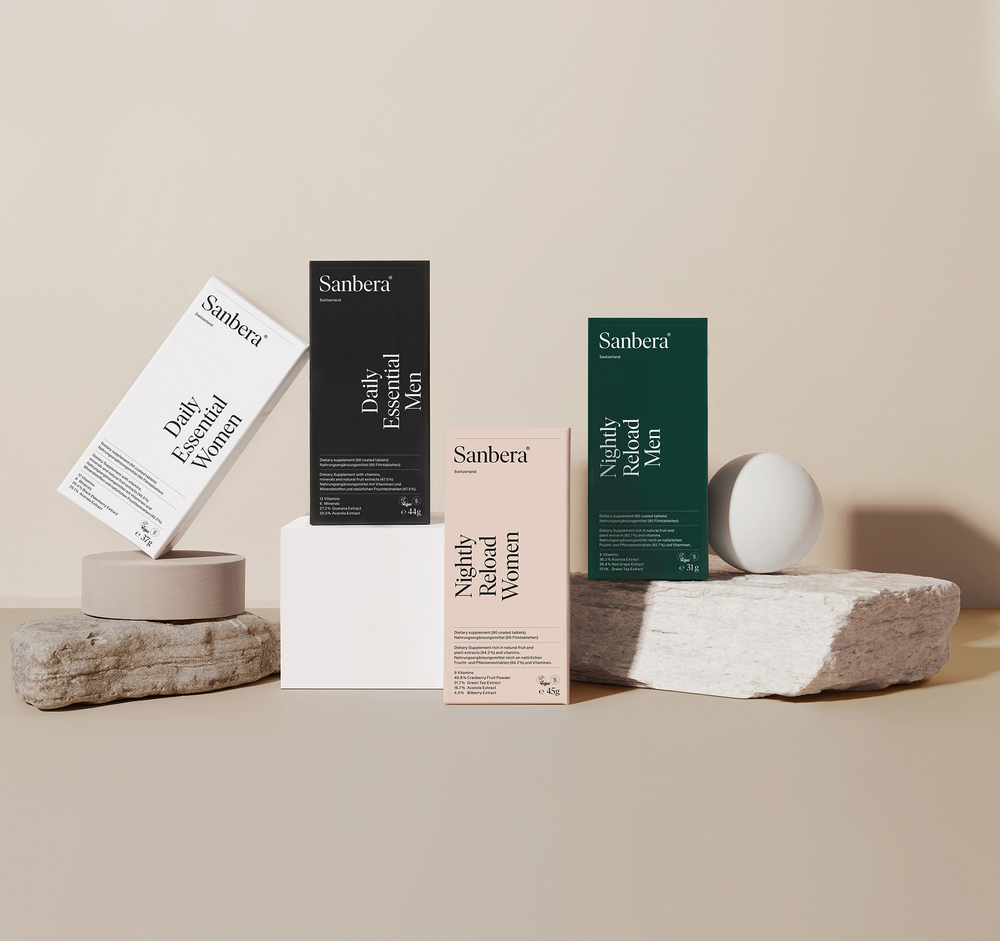
Sanbera’s range is organised around two distinct moments in the day rather than an extensive collection of separate products.
Daily Essential is the daytime formula, created around nutritional needs associated with energy metabolism, immunity, focus, and everyday performance. Nightly Reload is the complementary evening formula, developed to accompany the body’s nighttime routine and recovery. Both are available in formulations for women and men.
This Day & Night structure gives each formula a defined role. It also makes the range easier to understand: daytime nutritional support when the day begins, followed by a separate formula for the evening.
The result is a consistent ritual built around timing, purpose, and the different rhythms of daily life.
Recyclable glass and paper packaging
Packaging has an essential role in protecting a supplement from light, moisture, and environmental exposure. At the same time, it becomes part of the product’s environmental footprint.
Sanbera uses glass jars and paper boxes that are recyclable after use. Glass provides a durable way to protect the tablets. The paper outer packaging can enter the appropriate recycling stream.
We encourage customers to separate the packaging components and recycle them according to the local guidance in their municipality. Recycling systems vary between Switzerland, the European Union, and other regions, so following local instructions remains important.
Our approach is not to suggest that packaging has no impact. It is to choose materials deliberately and continue looking for responsible ways to balance product protection, quality, and waste reduction.
Supporting social participation through VEBO
VEBO completes the final stages of Sanbera’s packaging in Switzerland.
VEBO supports the professional and social integration of people with health impairments. Its work includes employment, training, residential, and advisory services designed to strengthen participation, develop skills, and build confidence.
This partnership allows an important part of Sanbera’s production process to support meaningful work within the local Swiss community.
For us, responsible business is not limited to environmental considerations. It also concerns people, access, and the value created through long-term local relationships.
Supporting Biovision with every product sold
With every Sanbera product sold, a fixed amount supports the ecological programmes of the Biovision Foundation.
Swiss World Food Prize recipient Dr Hans Rudolf Herren founded Biovision in 1998. The foundation works to improve food security and reduce poverty through ecological approaches that support people and the environment.
Its work reflects the close relationship between human wellbeing, sustainable food systems, healthy ecosystems, and resilient communities.
Through this contribution, each Sanbera purchase becomes connected to work that extends beyond the product itself.
Is sustainability the same as luxury?
Not necessarily.
Traditional ideas of luxury often centre on excess, status, or exclusivity. Sanbera takes a quieter view. For us, premium quality is found in precision, thoughtful formulation, trusted partnerships and the care given to each detail.
A beautifully presented supplement should also have substance behind it. Substance begins with a considered formula and clear production standards. Purposeful packaging protects the product, while responsible communication keeps every claim precise.
This is where conscious luxury and sustainability can meet: not through extravagance, but through discernment.
Choosing well. Using thoughtfully. Expecting quality without losing sight of responsibility.
How can you choose sustainable supplements?
When comparing sustainable supplements, look beyond the front of the packaging. A few practical questions can reveal much more about the product, its production and the commitments behind it:
Is the supplement vegan or independently certified?
A recognised certification provides more clarity than an unsupported vegan or plant-based statement.
Where is the supplement made?
Transparent information about the country of production and manufacturing partners can help you assess the standards behind the product.
Can the packaging be recycled locally?
Check the individual components rather than relying only on broad terms such as “eco-friendly.”
Does the brand explain its partnerships?
Specific organisations, manufacturers, and social initiatives are more meaningful than general statements about giving back.
Are the sustainability claims precise?
Responsible brands should distinguish between recyclable, recycled, biodegradable, carbon-neutral, and plastic-free. These terms do not mean the same thing.
Is the product designed for consistent use?
A supplement that fits naturally into daily life is less likely to be forgotten, duplicated, or discarded.
How does Sanbera create more sustainable supplements?
Sanbera puts sustainability into practice across three connected areas: how its supplements are formulated, how they are made and packaged, and how the business contributes beyond the finished product.
Within the formulas, Sanbera uses plant-based ingredients and excludes GMOs and unnecessary additives. The entire range carries the Vegan Trademark, providing independent confirmation that defined vegan standards apply to the ingredients and manufacturing process.
Within production, Sanbera works with Dixa in St. Gallen, drawing on more than a century of Swiss experience with herbs and natural raw materials. Supplements are made in small batches, presented in recyclable glass and paper packaging, and completed in partnership with VEBO, connecting the final packaging process to social participation within Switzerland.
Beyond the product, every sale contributes a fixed amount to the ecological programmes of the Biovision Foundation. Sanbera’s Day & Night system also keeps the range focused: distinct daytime and evening formulas, created for women and men, with a clear place in a consistent routine.
Together, these practices define Sanbera’s present approach. They are not presented as proof of a perfect or impact-free product, but as specific commitments that can be identified, explained, and developed over time.
Sustainability remains a process of attention: knowing what has already been put in place, communicating it honestly and continuing to examine what can be improved.
A more considered daily ritual
Choosing sustainable supplements is a personal decision, but it can also reflect something wider: the ingredients we prefer, the standards we trust, and the kinds of businesses we choose to support.
That choice can support plant-based products, strengthen local partnerships and contribute to ecological programmes. A thoughtfully designed formula can also make room for a daily wellbeing ritual that feels considered rather than excessive.
Sanbera brings these choices together in Swiss-made formulations created for modern life: precise, plant-based, and thoughtfully connected to the world in which they are made.
Frequently asked questions
Are Sanbera supplements sustainable?
Yes. Sanbera approaches sustainability through vegan formulas, Swiss production, recyclable glass and paper packaging, local collaboration with VEBO, and a fixed contribution to the Biovision Foundation with every product sold.
Are Sanbera supplements vegan?
Yes. Sanbera supplements are plant-based and carry the Vegan Flower of the Vegan Society. They contain no animal ingredients or animal-derived by-products.
Where are Sanbera supplements made?
Sanbera supplements are formulated and made in Switzerland in collaboration with Dixa in St. Gallen.
Is Sanbera’s packaging recyclable?
Sanbera’s glass jars and paper boxes are recyclable. Customers should separate the packaging components and follow the recycling guidance provided by their local municipality.
How does Sanbera support Swiss communities?
The final stages of Sanbera’s packaging are completed in partnership with VEBO, a Swiss institution supporting the professional and social integration of people with health impairments.
Does Sanbera support environmental organisations?
Yes. With every Sanbera product sold, a fixed amount supports ecological programmes run by the Swiss Biovision Foundation.
Originally published July 17, 2023 · Updated August 27, 2026