


No supplement can rejuvenate your skin or your cells, and none is authorised to claim it in Switzerland or the EU. What nutrition can do is supply what your skin needs to stay normal: vitamin C for normal collagen formation, and vitamin A, zinc, biotin, niacin, riboflavin and iodine for the maintenance of normal skin. Because the outer layer of your skin renews itself in about four to six weeks, give any change two to three months before you judge it, and remember that sun protection and not smoking matter more than any tablet.
Key facts about skin and nutrition
- The epidermis, the outer layer of your skin, renews itself in roughly four weeks in young adults; the process slows with age.
- UV radiation is the main external cause of visible skin ageing. Daily sun protection has far stronger evidence than any supplement.
- Swiss nutrition recommendations: five portions of vegetables and fruit a day (three of vegetables, two of fruit).
- Adults under 65 need about 0.8 g of protein per kg of body weight a day, and about 1.0 g from 65 (D-A-CH).
- Vitamin C needs (95–110 mg a day) are met by one red pepper and one kiwi.
- More is not better: upper limits apply, for example 3,000 µg of preformed vitamin A, 25 mg of zinc and 255 µg of selenium a day.
Do skin rejuvenation supplements work?
"Rejuvenation" is a marketing word, not a scientific or legal category. In the EU and Switzerland, a food supplement may only make the health claims listed in the official register, and none of them mentions younger skin, fewer wrinkles or rejuvenated cells. The authorised skin-related claims are short and specific:
- vitamin A, riboflavin, niacin, biotin, zinc and iodine contribute to the maintenance of normal skin;
- vitamin C contributes to normal collagen formation for the normal function of the skin;
- copper contributes to normal skin pigmentation;
- vitamin C, vitamin E, riboflavin, zinc and selenium contribute to the protection of cells from oxidative stress.
In other words, nutrition supports normal skin. If your intake of these nutrients is low, correcting it matters. If it is already adequate, extra amounts are not known to make skin look younger. For each nutrient's role and best food sources, see which vitamins are good for your skin.
What about "cellular rejuvenation" supplements?
Products sold for cellular rejuvenation or longevity usually contain ingredients such as NMN or other NAD+ precursors, resveratrol, collagen peptides or hyaluronic acid. Studies have looked at all of them, but human evidence for visible skin effects is limited, often short-term and frequently funded by manufacturers. No health claim is authorised for any of these ingredients in the EU or Switzerland, and some are not approved for sale as food in every country.
Collagen peptides are the most researched. Several trials have reported changes in skin hydration or elasticity, but results vary and no claim is authorised. Your body also makes its own collagen, provided it gets enough protein and vitamin C. For a closer look at what cell renewal actually involves, read real cell rejuvenation.
How long does it take for nutrition to show in your skin?
Skin cells form in the lowest layer of the epidermis and travel to the surface, where they are shed. This takes roughly four weeks in young adults and longer later in life. Nails grow about 3 mm a month, so they take even longer to reflect a change.
| Time frame | What is realistic |
|---|---|
| First weeks | Your nutrient intake and blood levels change; the skin surface does not yet. |
| 1–3 months | A full skin renewal cycle has passed. If you had a real shortage, this is when a difference may become visible. |
| 3 months and longer | A fair point to review your diet or supplement. Without a previous shortage, expect no visible change. |
If your skin changes suddenly or a problem persists despite a balanced diet, see a doctor or dermatologist rather than adding more supplements.
Food first: a daily plate for skin from within
A varied diet supplies all skin-relevant nutrients at once, together with fibre and plant compounds that tablets do not contain. A simple day could look like this:
| Meal | Example | Skin-relevant nutrients |
|---|---|---|
| Breakfast | Oat flakes with yoghurt or fortified soy yoghurt, berries and pumpkin seeds | Zinc, biotin, riboflavin, vitamin C |
| Lunch | Lentil salad with raw red pepper, rocket and rapeseed oil | Vitamin C, zinc, niacin, vitamin E, beta-carotene |
| Snack | A kiwi and a handful of almonds, plus one Brazil nut | Vitamin C, vitamin E, selenium |
| Dinner | Salmon or tofu with baked sweet potato and broccoli, cooked with iodised salt | Beta-carotene, vitamin C, niacin, iodine |
Add about 1.5 litres of water or unsweetened drinks a day. Drinking more than you need does not hydrate the skin further, but too little shows quickly in how you feel.
When a supplement makes sense, and when it doesn't
A supplement is useful when your diet does not cover your needs. This is more likely if you:
- eat a vegan or largely plant-based diet (watch zinc, iodine and selenium);
- eat few vegetables and fruit, or follow restrictive diets;
- are older, when appetite and absorption often decline;
- are pregnant or planning a pregnancy (choose a product made for this and ask your doctor).
It makes less sense when your diet is already varied, or when you would stack several products. Hair, skin and nail supplements often repeat the nutrients already in a multivitamin. Add up the totals, keep below the upper limits, avoid high-dose vitamin A in pregnancy and high-dose beta-carotene if you smoke, and ask a doctor or pharmacist if you take medication. Our article on which dietary supplements are most useful helps you decide.
Habits that matter more than any supplement
- Sun protection: broad-spectrum sunscreen, shade and clothing, every day of the year.
- Not smoking: smoking is strongly linked to earlier wrinkles.
- Alcohol in moderation and a regular sleep pattern.
- Gentle skincare: mild cleansing and a moisturiser that suits your skin type.
Nutrition supports this foundation; it cannot replace it. For the topical side, see our skincare routine guide.
Where Sanbera fits
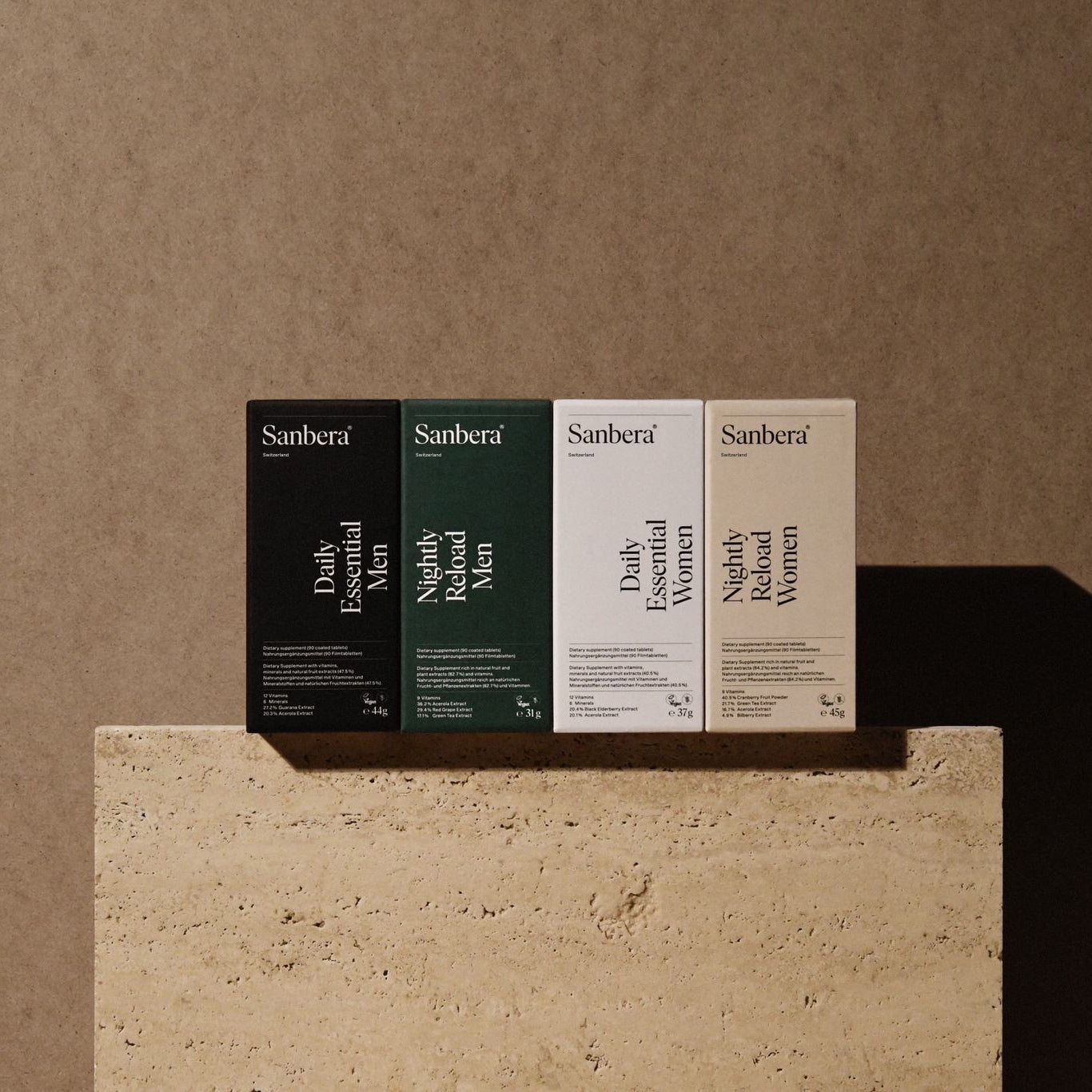
Sanbera is not a rejuvenation product, and we do not claim that it makes skin look younger. Our formulas are designed to complement a balanced diet with the nutrients described above, in moderate amounts. Per daily dose of 3 tablets, Daily Essential Women provides 43.1 mg of vitamin C (54% NRV), 200 µg of vitamin A (25%), 12 mg of niacin (75%), 1.05 mg of riboflavin (75%), 25 µg of biotin (50%), 2.5 mg of zinc (25%) and 37.5 µg of iodine (25%). Daily Essential Men contains the same vitamin A, riboflavin, biotin and iodine, with 51.8 mg of vitamin C (65%), 8 mg of niacin (50%) and 4 mg of zinc (40%).
Vitamin C contributes to normal collagen formation for the normal function of the skin, and vitamin A, riboflavin, niacin, biotin, zinc and iodine contribute to the maintenance of normal skin. The Day + Night set for women combines Daily Essential Women with Nightly Reload Women (vitamin C and eight B vitamins); men can start with Daily Essential Men.
Frequently asked questions
Do skin rejuvenation supplements really work?
No supplement is authorised to rejuvenate skin in the EU or Switzerland. Nutrients such as vitamin C, vitamin A, zinc, biotin, niacin, riboflavin and iodine support normal skin, and correcting a real shortage is worthwhile. If your diet already covers your needs, extra amounts are not known to make skin look younger. Sun protection and not smoking have much stronger evidence.
Are there supplements for cellular rejuvenation?
Many products are marketed for it, often with NMN, resveratrol or collagen. Studies have looked at these ingredients, but evidence in humans is limited and no health claim is authorised for them. Your cells renew themselves continuously; what they need from your diet is an adequate supply of energy, protein, vitamins and minerals.
How long does it take for vitamins to show in your skin?
The outer skin layer renews itself in roughly four to six weeks, more slowly with age. If you had a real shortage, a difference may become visible after one to three months. Review any change in diet or supplements after about three months. Without a previous shortage, do not expect a visible change.
Is it better to get skin nutrients from food or supplements?
Food comes first. It supplies all skin-relevant nutrients together with protein, fibre and plant compounds that tablets do not contain. A supplement is useful to close a specific gap, for example on a vegan diet or when you eat few vegetables. It should complement a balanced diet, not replace it.
Can I combine a skin supplement with a multivitamin?
Often yes, but check the totals. Skin, hair and nail products frequently contain the same nutrients as a multivitamin. Keep total intake below the upper limits: 3,000 µg of preformed vitamin A, 25 mg of zinc and 255 µg of selenium a day. Ask a doctor or pharmacist if you are pregnant or take medication.
Sources
- Schagen SK, Zampeli VA, Makrantonaki E, Zouboulis CC. Discovering the link between nutrition and skin aging. Dermato-Endocrinology, 2012.
- Park K. Role of micronutrients in skin health and function. Biomolecules & Therapeutics, 2015.
- Linus Pauling Institute, Oregon State University: Micronutrients and skin health
- European Commission: EU Register of nutrition and health claims
- Federal Food Safety and Veterinary Office (FSVO/BLV): Swiss nutrition recommendations
- German Nutrition Society (DGE): D-A-CH reference values for nutrient intake
This article is for general information and does not replace advice from a doctor or pharmacist. Food supplements are not a substitute for a varied, balanced diet and a healthy lifestyle.